Bayonne Superior Roofing installs metal roofing in Bayonne, NJ, serving surrounding cities including Roselle Park, North Arlington, Guttenberg, East Rutherford and Rutherford. In 20+ years of roofing on local houses, we have found that standing seam metal earns its place most often on the parts of a roof where shingles struggle: low-pitch porches, bay windows, rear additions and dormers that drain slowly.
We install standing seam metal roofs on whole houses as well as on those smaller sections, and we fabricate the metal flashing, coping and edge trim that ties a metal roof into brick walls, parapets and shingle roofs next to it. The details where metal meets another material are where a metal roof either stays watertight or does not.
Because the city is surrounded by water on three sides, we also pay attention to the metal itself, the coating and the fasteners. A roof that looks good on installation day has to keep its finish and its fastenings through years of wind, rain and salt air.
Standing Seam Metal Roofing
How Standing Seam Panels Work
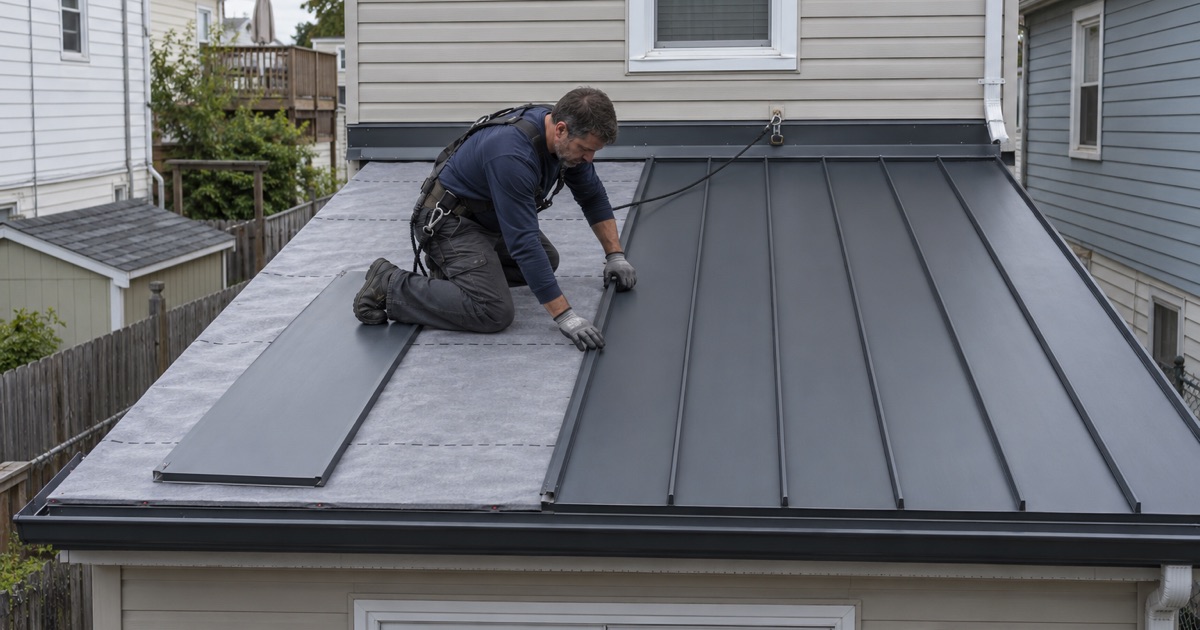
Standing seam panels run from the ridge to the eave in one piece, with raised seams where each panel locks to the next. The fasteners are hidden under the seams, attached with clips that let the metal expand and contract with temperature changes, so there are no exposed screws through the roof surface to loosen and leak over time.
Under the panels we install underlayment suited to metal and self-adhering ice and water barrier at the eaves and valleys. The panels then go down with closures at the ridge and eave to keep out wind-driven rain and insects.
Where Standing Seam Fits on Local Houses
Many older houses in the area have porch roofs, bay window tops and rear additions with very little slope. Shingles on those sections tend to leak because water moves too slowly across them and gets pushed under the laps in wind. A standing seam panel sheds water at a much lower pitch.
We often install metal on just those sections while the main roof stays shingled. The key is the transition flashing where the two roofs meet, which we form on site so it fits the actual angles of the house rather than a stock piece that almost fits.
Materials and Finishes
Steel, Aluminum and Exposure to Salt Air
Most residential standing seam is coated steel or aluminum. Steel is strong and widely available in many colors, while aluminum does not rust and is often preferred near salt water. On a peninsula with open water on three sides, we discuss the exposure of your particular roof and choose the material and fasteners accordingly.
Whatever the panel material, the fasteners, clips and trim must be compatible with it. Mixing metals that react with each other, or using plain steel fasteners where stainless or coated ones belong, is a common reason metal trim stains and corrodes early.
Paint Finishes and Colors
Factory-applied paint finishes protect the metal and hold their color far better than field-painted metal. Darker grays, charcoal, black and dark bronze are popular on brick houses, and lighter colors reflect more sun on a roof over living space.
We bring color samples to the house, because a metal panel catches light differently than shingles, and a color chosen indoors from a small chip can look quite different on a sunny porch roof.
Metal on Commercial and Flat Roof Details
Commercial Metal Roofing
On commercial buildings, metal roofing appears on sloped sections, canopies, mansards and entrance roofs, while the main flat roof is usually a membrane. We install and repair metal panels on those sections and coordinate the details where they meet the flat roof system.
Mixed-use buildings with storefronts often have a metal-clad mansard or canopy over the shop windows. Those sections take wind directly from the street and shed water onto the sidewalk, so we check the panel fastening, the gutter or drip detail at the bottom edge and the flashing where the mansard meets the flat roof behind it.
Repairing Existing Metal Roofs
Older metal roofs with exposed screws often leak where the rubber washers under the screw heads have dried out and cracked. We replace failed fasteners with new gasketed ones, reseal laps and reflash penetrations, which can add years to a roof that is otherwise sound.
Where rust has eaten through panels or the seams have opened along whole runs, we tell you honestly that repair has reached its limit and price a replacement alongside the repair, so you can compare the two.
Coping, Edge Metal and Flashing
Metal coping caps parapet walls, edge metal finishes the perimeter of flat roofs and formed flashing seals chimneys, walls and transitions. We fabricate and install these pieces so they overlap in the right direction, are fastened to resist wind uplift at the roof edge and leave room for the metal to move with the seasons.
Well-made coping and edge metal protect the top of the wall and the edge of the membrane, which are two of the places flat roofs leak most often. They are also the pieces most exposed to wind, so their fastening matters as much as their fit.
Living With a Metal Roof
Snow Guards and Sliding Snow
Snow slides off metal more easily than off shingles. Over entrances, walkways, driveways and narrow side yards shared with a neighbor, we install snow guards so snow melts off gradually rather than dropping in a single sheet.
The guards are clamped to the seams or fastened with the panel system’s own hardware, laid out in rows sized to the length of the slope. On a small porch roof one row may be enough; a long main roof over a walkway needs more.
Metal Roofing and Solar Panels
Standing seam roofs accept seam clamps that hold solar racking without drilling through the panels. If you plan to add solar, a metal roof can be laid out with the array in mind, and the clamps avoid the roof penetrations that other roof types need.
- 20+ Years in Roofing
- Line-Item Written Estimates
- Daily Nail-Magnet Cleanup