
Bayonne Superior Roofing handles emergency roof repair in Bayonne, NJ, serving surrounding cities including Roselle Park, North Arlington, Guttenberg, East Rutherford and Rutherford. When wind tears off a section of shingles, a limb comes through the roof or water starts pouring through a ceiling, the first goal is stopping the water, and with 20+ years on local roofs we know how to do that without making the eventual repair harder.
Emergency work comes in two parts. The first is temporary protection: a tarp fastened properly over the opening, a patch on a torn flat roof membrane or a cleared drain on a roof that is flooding. The second is the permanent repair, made once the weather settles and the damage has been assessed and documented.
Throughout both parts, we photograph and write up what we find, so you have your own record for an insurance claim. When you ask, our crew will meet your adjuster on site to show the damage, while the claim itself stays between you and your insurer.
What Counts as a Roofing Emergency
Storm Openings and Tree Strikes
A falling limb or tree can puncture the roof deck, crack rafters and leave an open hole above living space. Water gets in quickly through an opening like that, and the damage to insulation, ceilings and wiring grows with every hour of rain.
We secure the opening, cut away loose debris that could fall into the house and check the framing around the strike from inside the attic. If a rafter is broken, we tell you plainly, because structural damage needs proper repair rather than a tarp stretched over a sagging section.
Blown-Off Shingles and Exposed Decking
High winds often lift and tear away whole sections of shingles at the eaves, rakes and ridge, leaving underlayment or bare decking exposed. Underlayment alone sheds some water for a short time, but it is not designed to be the roof, and bare decking soaks up rain.
We cover exposed areas promptly and, when conditions allow, replace the missing shingles the same visit. Hand-sealing the shingles around the damaged area keeps the next gust from peeling back more of the roof.
Active Leaks Into Living Space
Water dripping through a light fixture, running down a wall or pooling in a sagging ceiling is an emergency even if the roof looks intact from the ground. The source might be a failed flashing, a clogged scupper backing water up on a flat roof or ice dams forcing meltwater under the shingles.
We find the source first, then stop it, whether that means a temporary patch, clearing a blocked drain or opening a channel through an ice dam. A leak stopped at its source does far less damage than one only caught in buckets.
Temporary Protection Done Properly
Tarping That Stays Put
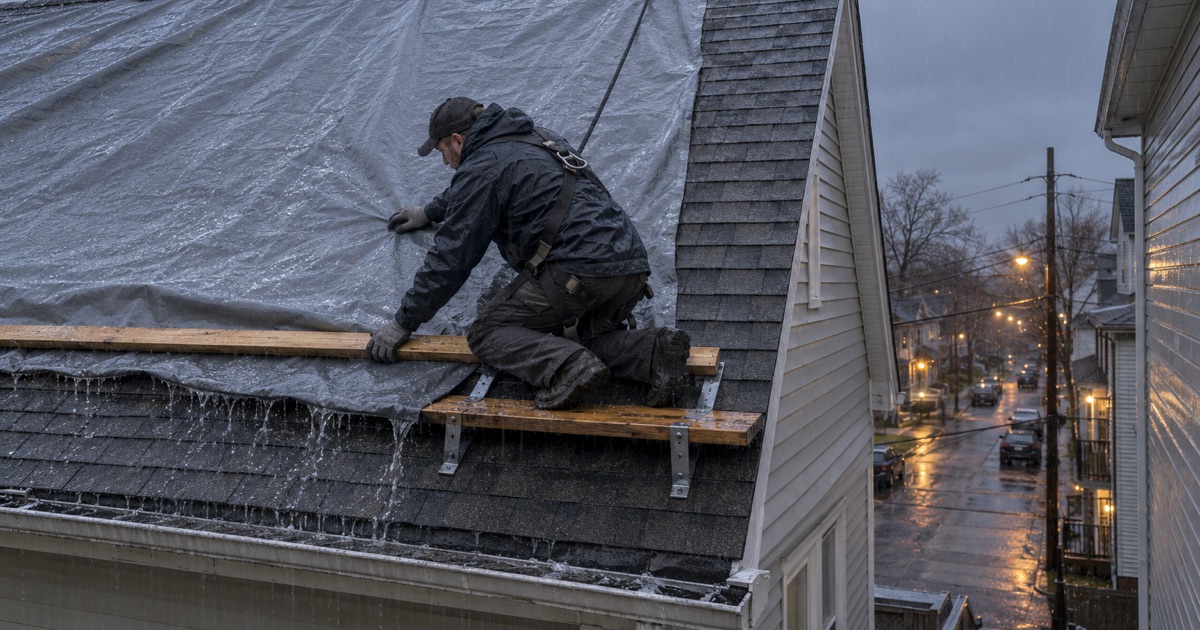
A tarp that is only held down with bricks or a few nails through the plastic usually ends up in the yard after the next gust. We run the tarp over the ridge where possible, fasten it through wood battens into the roof framing and lap it so water flows over the edges instead of under them.
That method also limits damage to the roof itself, so the fastener holes are in places that will be covered by the permanent repair. Before anything is covered, the damage is photographed for your records.
Emergency Flat Roof Patches
On the low-slope rear roofs of two-family houses and the flat roofs of mixed-use buildings, a torn membrane or an open seam can let water straight into the top floor. We patch torn membrane with compatible material, clear clogged drains, scuppers and box gutters, and pump or sweep standing water off the roof where it is pooling.
Those temporary steps can hold until the roof is dry enough for a permanent repair. If the damage covers a large area, we tell you so and plan the replacement with you.
Coordinating With Tenants
In a two-family or multifamily house, an emergency often affects the unit upstairs first. We coordinate access with the tenants and the owner, so the attic or top-floor ceiling can be checked quickly and everyone knows when the crew will be on the roof.
Emergency Work and Bayonne Permits
Emergency Notice and the 72-Hour Rule
Where a permit applies, the Bayonne Building Department accepts notice of emergency roof work by email, with the company name, address, phone number and a description of the work. The contractor then has 72 hours to come in and obtain the permits. We handle that notice so the emergency repair is not delayed and the paperwork is in order.
Re-roofing a detached one- or two-family house falls under New Jersey’s ordinary maintenance rule and does not need a permit, while attached houses and buildings with three or more units do. We tell you which applies to your building.
Documentation for Your Claim
We photograph the damage before temporary repairs, during the work and after the opening is secured, and we write up the cause and extent of the damage. That gives you a clear record to submit with your claim and to compare against the insurer’s own estimate.
Keep every receipt for tarps, temporary repairs and any emergency services. Under New Jersey rules, insurers must acknowledge a claim within 10 working days, and having the documentation ready from the start helps the claim move along.
From Temporary Fix to Permanent Repair
Assessing the Damage After the Storm
Once the weather clears, we inspect the whole roof and the attic, not just the area that was tarped. Storms often loosen flashing, crack shingles and damage gutters in places that did not leak right away, and finding them now prevents a second emergency.
Permanent Repair or Replacement
Smaller damage is repaired to match the existing roof. When the damage is widespread or the roof was already near the end of its life, we give you an itemized estimate for both repair and replacement, so you and your insurer can see the full picture before deciding.
Staying Ahead of the Next Storm
Watching the Forecast for the Hudson Zone
The National Weather Service issues forecasts and advisories for Bayonne under its Hudson County zone. When high winds or a coastal storm are forecast, clearing gutters, scuppers and drains ahead of time and securing loose items around the roof can prevent a lot of emergency calls.
- 20+ Years in Roofing
- Line-Item Written Estimates
- Daily Nail-Magnet Cleanup